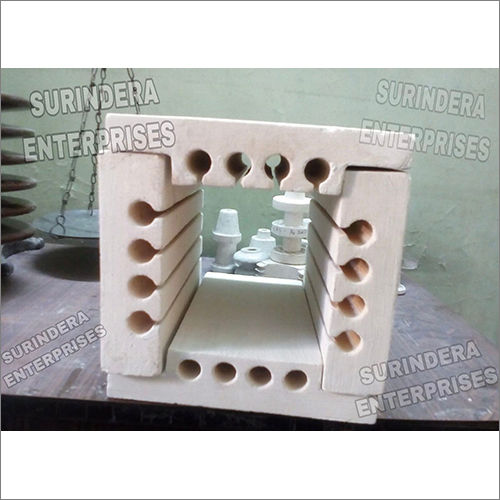
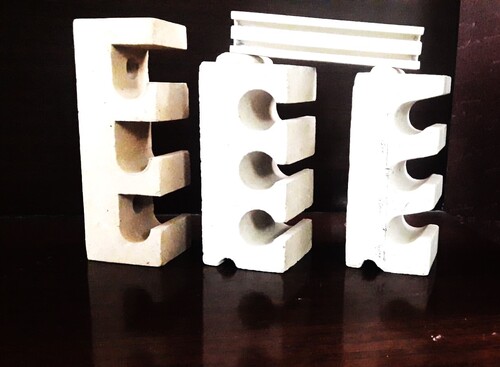
About Industrial Dia Spacer
Usage - Flow Of Liquid, Gas, Oil
Application - River, Canal Bridge Crossings, Road, Rail Crossings
Feature - Support And Electrically Insulate A Pipeline From Casing Pipe Through Which It Must Pass
Product Type - Dia Spacer
Size - 16 Hole
Precision Engineering for High-Temperature ApplicationsIndustrial Dia Spacers are expertly crafted to meet rigorous standards in refractory lining assemblies. Their dimensional stability, coupled with low porosity and high purity, allows consistent performance in environments up to 1600C. Whether you require standard or customized sizes, these spacers ensure operational reliability, safety, and efficiency in your industrial processes.
Versatile Material Choices and Robust Surface FinishAvailable in high alumina, mullite, or refractory oxide bases, Industrial Dia Spacers boast smooth finishes and low water absorption (<1.5%). Their advanced composition and manufacturing process deliver high compressive strength and a solid, durable form factor, accommodating even the most demanding thermal or mechanical stress applications.
FAQ's of Industrial Dia Spacer:
Q: How are Industrial Dia Spacers installed in refractory linings?
A: Industrial Dia Spacers are designed for straightforward integration into refractory lining assemblies. Due to their precise dimensions and cylindrical shape, they fit seamlessly between refractory layers, providing optimal spacing and insulating properties in high-temperature setups.
Q: What are the customizable options for the spacer's size and dimensions?
A: Customers can specify both inner and outer diameters, within the common ranges of 10-100 mm (inner) and 25-150 mm (outer), and request standard lengths from 100 mm up to 500 mm. This ensures compatibility with various industrial requirements and supports tailored insulation solutions.
Q: When should Industrial Dia Spacers be used?
A: These spacers are ideal when precise spacing and thermal insulation are needed in high-temperature industrial processes. Applications include kilns, furnaces, and ovens, where resistance to heat, corrosion, and abrasion is required to enhance performance and longevity of refractory linings.
Q: Where are these spacers most commonly applied?
A: They are extensively used in heavy industries such as ceramics, steel manufacturing, glass production, and any operation involving continuous or intermittent high-temperature processes that require durable and stable refractory components.
Q: What is the manufacturing process and which standards do Dia Spacers comply with?
A: Industrial Dia Spacers are manufactured using high-grade refractory materials, shaped and sintered under strict quality controls. The product complies with major industrial refractory standards such as ASTM and IS, ensuring reliable mechanical strength and thermal performance.
Q: What are the primary benefits of using Industrial Dia Spacers?
A: Key advantages include their high compressive strength, excellent thermal shock resistance, low thermal conductivity, dimensional stability under heat, and low porosity. These factors contribute to increased safety, reduced maintenance, and extended service life in industrial furnaces and kilns.
Q: How are Dia Spacers packaged and delivered?
A: Depending on the order size and customer requirements, spacers are securely packaged in wooden pallets or corrugated boxes to ensure protection during transportation and storage. Minimum order quantities and packaging specifications are determined as per the manufacturer's policy.

 Send Inquiry



 Send Inquiry

 Send Inquiry